Montclair Saw More Public Records Requests After New Jersey Changed OPRA
Montclair’s public portal recorded 257 more requests in the 11 months after New Jersey’s 2024 OPRA amendments—an 11% increase.

Ben Shore
• 5 min read
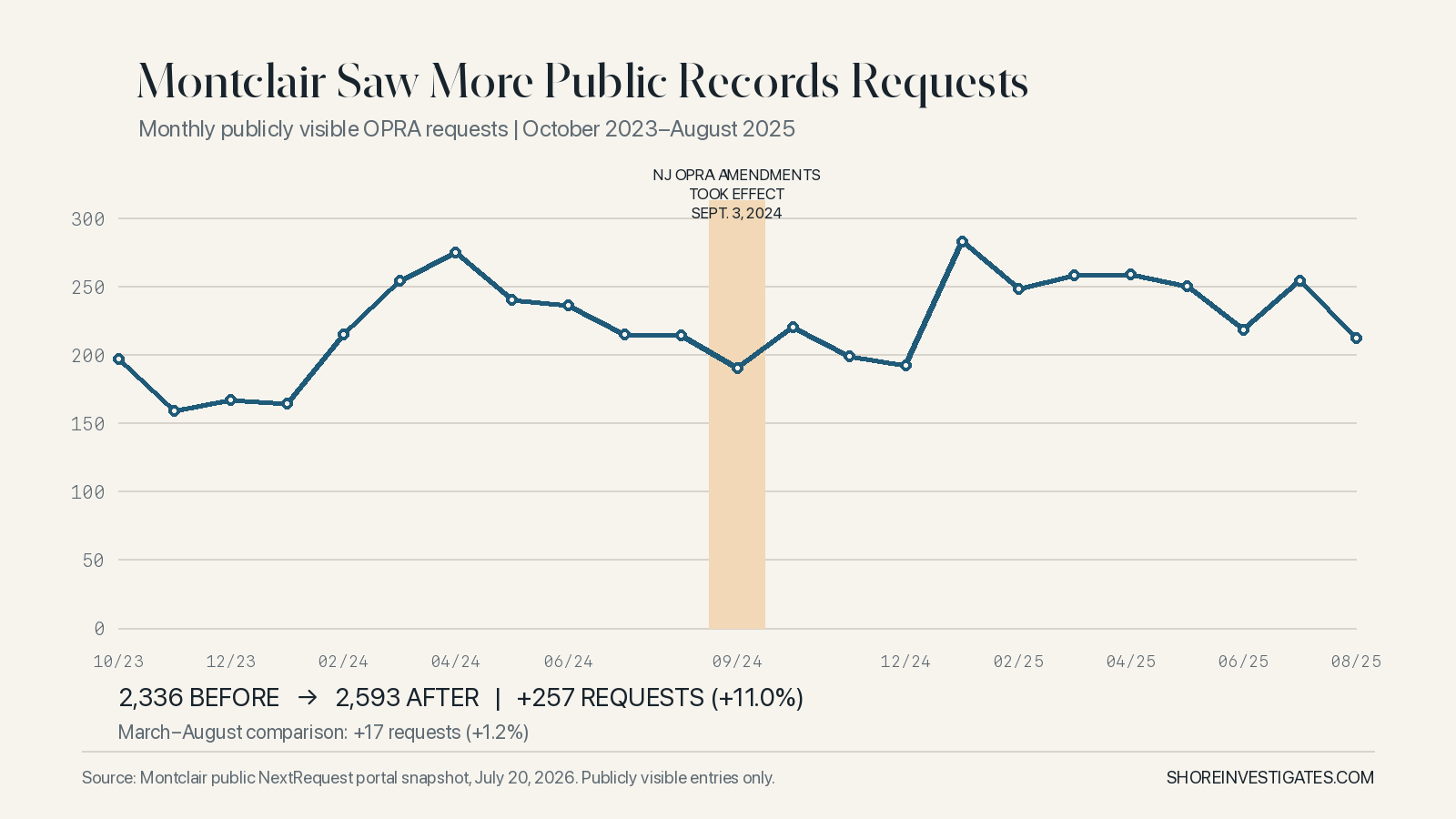
MONTCLAIR, NJ — Montclair’s public records portal recorded more requests after New Jersey changed the Open Public Records Act in 2024.
In the 11 months before the amendments took effect, the portal showed 2,336 publicly visible requests. In the same-length period afterward, it showed 2,593.
That is 257 additional requests, an increase of 11%.
The figures describe requests the public could see in Montclair’s NextRequest portal. They do not include requests that were restricted from public view or handled outside the portal, and they do not establish why the volume changed.
New Jersey approved the OPRA amendments on June 5, 2024. They took effect on September 3. Among other changes, the law requires commercial requesters to identify themselves and generally gives agencies 14 business days to respond to commercial-purpose requests when proper notice is provided. Montclair’s public portal does not show a decline in requests after those changes.
The 11-Month Comparison
Shore Investigates compared two equal periods: October 1, 2023 through August 31, 2024, and October 1, 2024 through August 31, 2025. September 2024 was treated as a transition month and excluded.
Using equal periods avoids comparing a partial year with a full year. The portal contained 190 visible requests in the excluded transition month; those requests were counted in the detailed study but not assigned to either side.
The result was 2,336 visible requests before the amendments and 2,593 afterward. January 2025 contributed substantially to the increase: the portal showed 283 requests that month, compared with 164 in January 2024.
Montclair’s earliest public request summaries date to September 27, 2023. The 11-month before period therefore begins near the start of the portal’s visible history, even though the two periods are equal in length.
What Happened to Delays?
The typical public closure time changed only slightly. The median request closed in 6.05 calendar days before the amendments and 6.68 days afterward.
Fewer requests remained open for long periods. The share not publicly closed within 30 days fell from 7.3% to 5.0%. The share not closed within 90 days fell from 3.4% to 1.5%.
Results varied by subject. Police and public-safety requests closed in a median 4.89 days before and 2.87 days afterward. Property, zoning and permit requests moved from 6.76 days to 11.04 days. The portal does not show one uniform change across every kind of request.
What Happened to Commercial-Looking Traffic?
The amendments require requesters to say whether records will be used for a commercial purpose. Montclair’s public data contained that question, but the answer was blank in all 5,119 detailed request records examined by Shore Investigates. The portal therefore could not show which requests met the law’s definition of commercial purpose.
That limitation prevents a direct before-and-after count of legally commercial requests using the public data alone.
Shore Investigates did not guess from a requester’s name, profession or subject. It examined two narrower measures for context. Requests displaying or identifying an organization - including law firms, real-estate businesses, news organizations and other named entities - increased from 156 before the amendments to 202 afterward. Their share rose from 6.7% to 7.8%. Those organizations are not necessarily commercial requesters under OPRA.
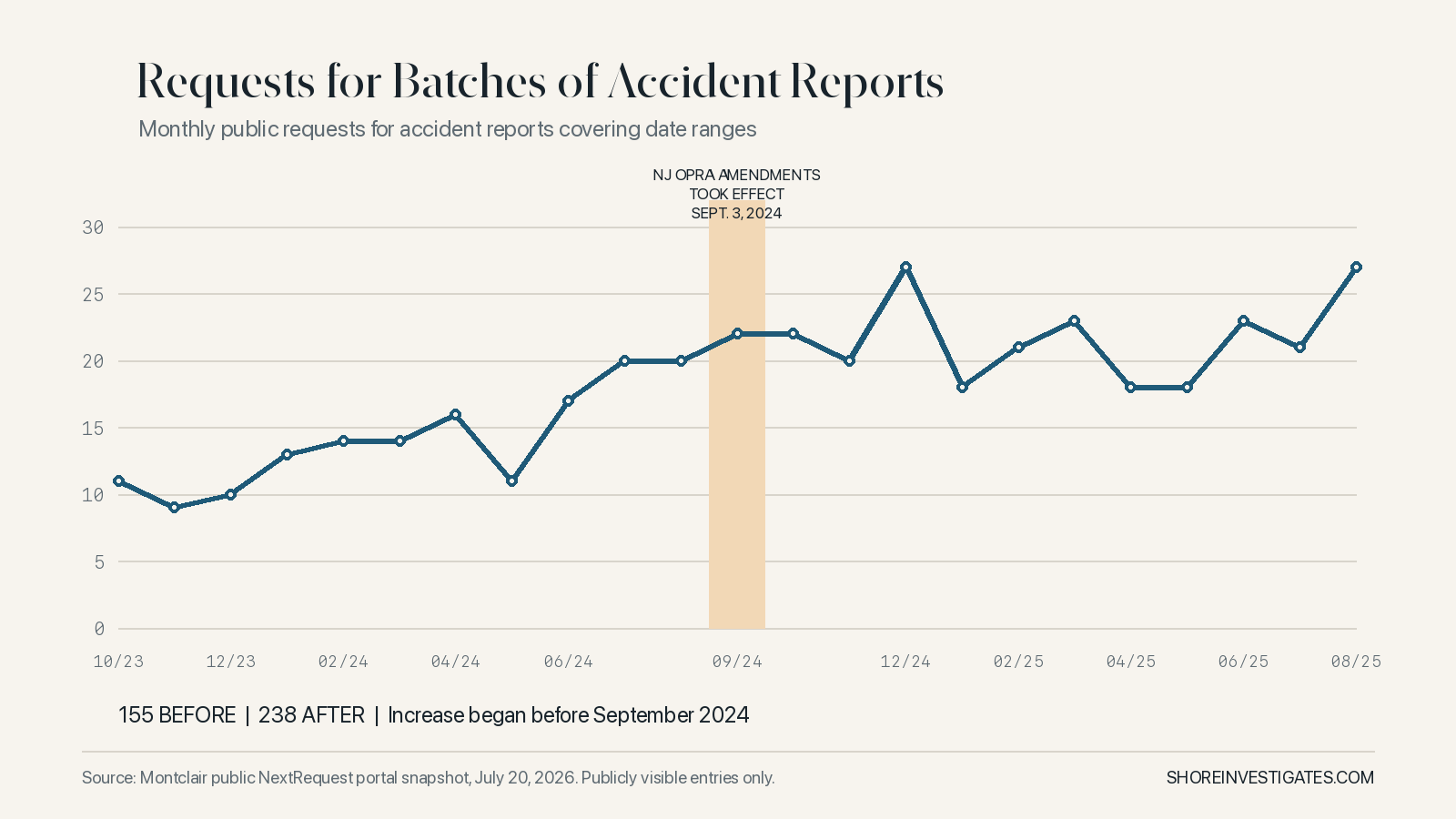
Requests seeking batches of motor-vehicle accident reports increased from 155 to 238, while their share rose from 6.6% to 9.2%. That trend began before September 2024, so it should not be attributed to the amendments.
The Mix of Requests Changed
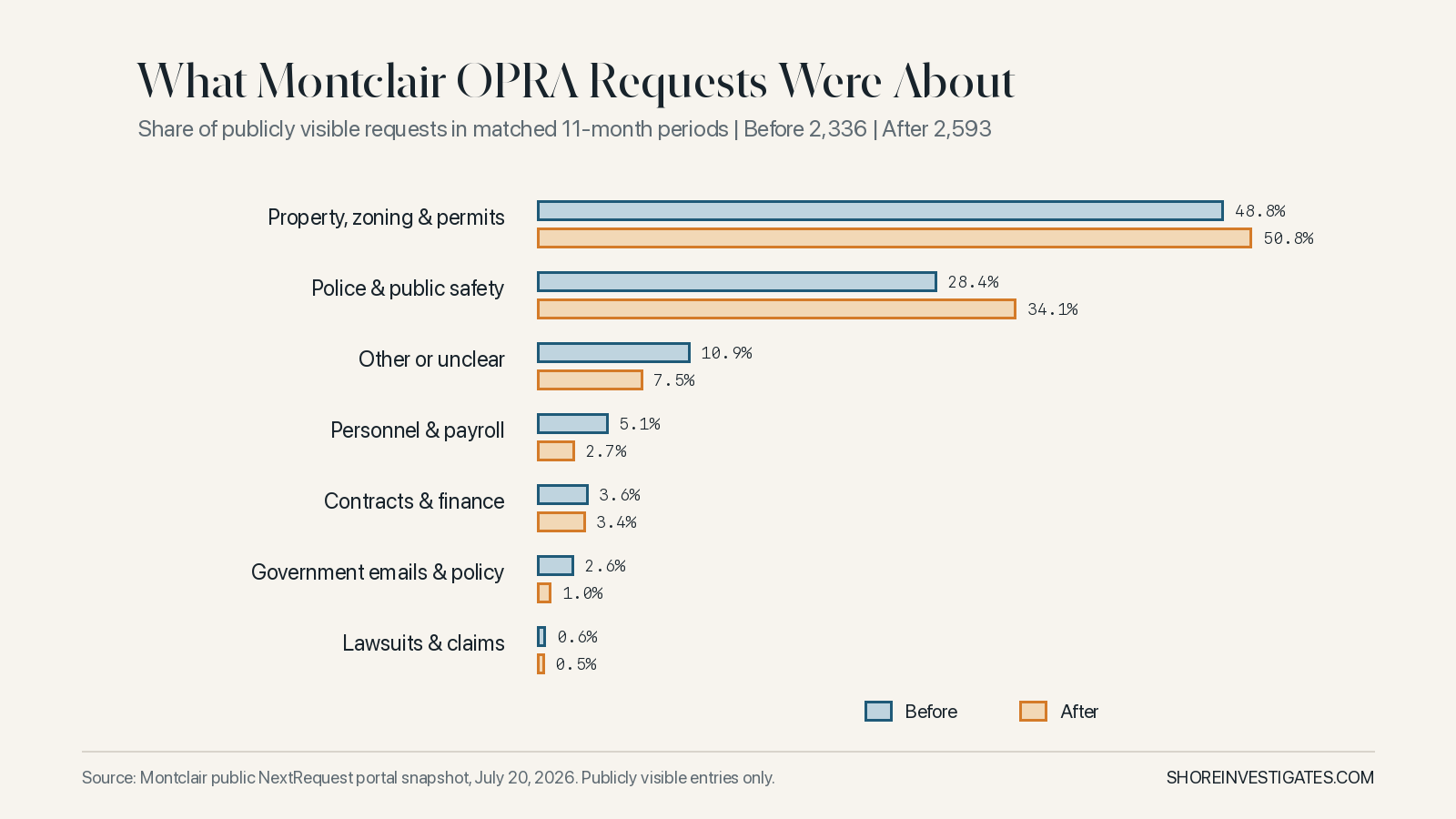
Property, zoning and permit records remained the largest group, rising from 48.8% to 50.8% of visible requests. Police and public-safety requests increased from 28.4% to 34.1%. Personnel and payroll requests fell from 5.1% to 2.7%, while government correspondence and policy requests fell from 2.6% to 1.0%.
In raw numbers, property-related requests rose from 1,140 to 1,317, while police and public-safety requests rose from 663 to 883.
What the Portal Shows
Shore Investigates captured all 7,721 publicly visible summaries in Montclair’s portal on July 20, 2026. The detailed study covered 5,119 requests in the matched periods and the September 2024 transition month. The dataset contained no duplicate request IDs, no missing in-scope IDs and no timeline-count discrepancies.
Request topics and the narrow organizational and accident-report measures were classified under documented rules and checked through audited samples.
A public portal is not a complete record of every request Montclair received. Restricted requests may not appear, off-portal requests may be absent, and private communications may not be visible. The data describes what the public could see; it does not prove that the OPRA amendments caused the changes.
The bottom line is straightforward: Montclair’s public portal showed more requests after New Jersey changed OPRA. The matched 11-month periods showed 257 additional requests, and the separate March-through-August periods showed 17 additional requests. The size differed because the analyses used different windows, but both recorded an increase.
Sources
New Jersey Legislature — P.L. 2024, c.16 (June 5, 2024) — The enacted OPRA amendments and 90-day effective-date provision.
New Jersey Government Records Council — Readable Version of OPRA (September 3, 2024) — The OPRA text as amended and effective September 3, 2024.
New Jersey Government Records Council — Citizen's Guide to OPRA, Fifth Edition (October 2024) — Official guidance on commercial-purpose certifications and response periods.
Township of Montclair — Open Public Records Act (Accessed July 20, 2026) — Montclair's OPRA procedures, effective date, and commercial-purpose guidance.
Township of Montclair — Public NextRequest Portal (Snapshot July 20, 2026) — Source of the 7,721 public summaries and 5,119 detailed request histories analyzed by Shore Investigates.
Stay Informed
Get our latest investigative stories delivered directly to your inbox. No spam, just quality journalism.
Comments (0)
Sign in to join the conversation
No comments yet. Be the first to share your thoughts!
More Stories
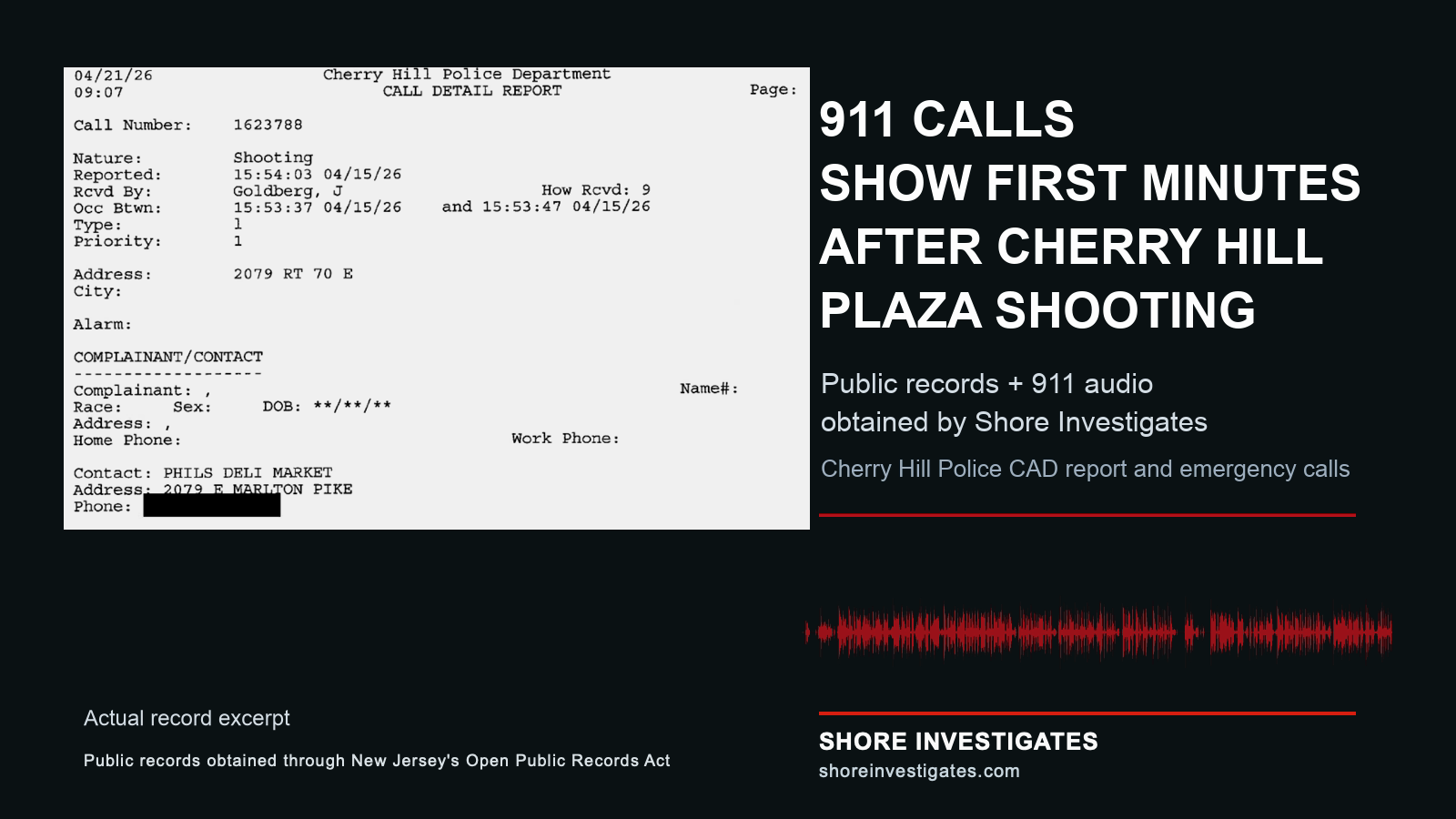
911 Calls, Police Logs Show First Minutes After Cherry Hill Shopping Plaza Shooting
Public records obtained by Shore Investigates show the first minutes after a man was reported shot outside a Cherry Hill shopping plaza. The 911 calls and dispatch records show how the response unfolded before police and prosecutors announced charges two days later.
What Cherry Hill’s Internal Affairs Reports Show, and How Residents Can File a Complaint
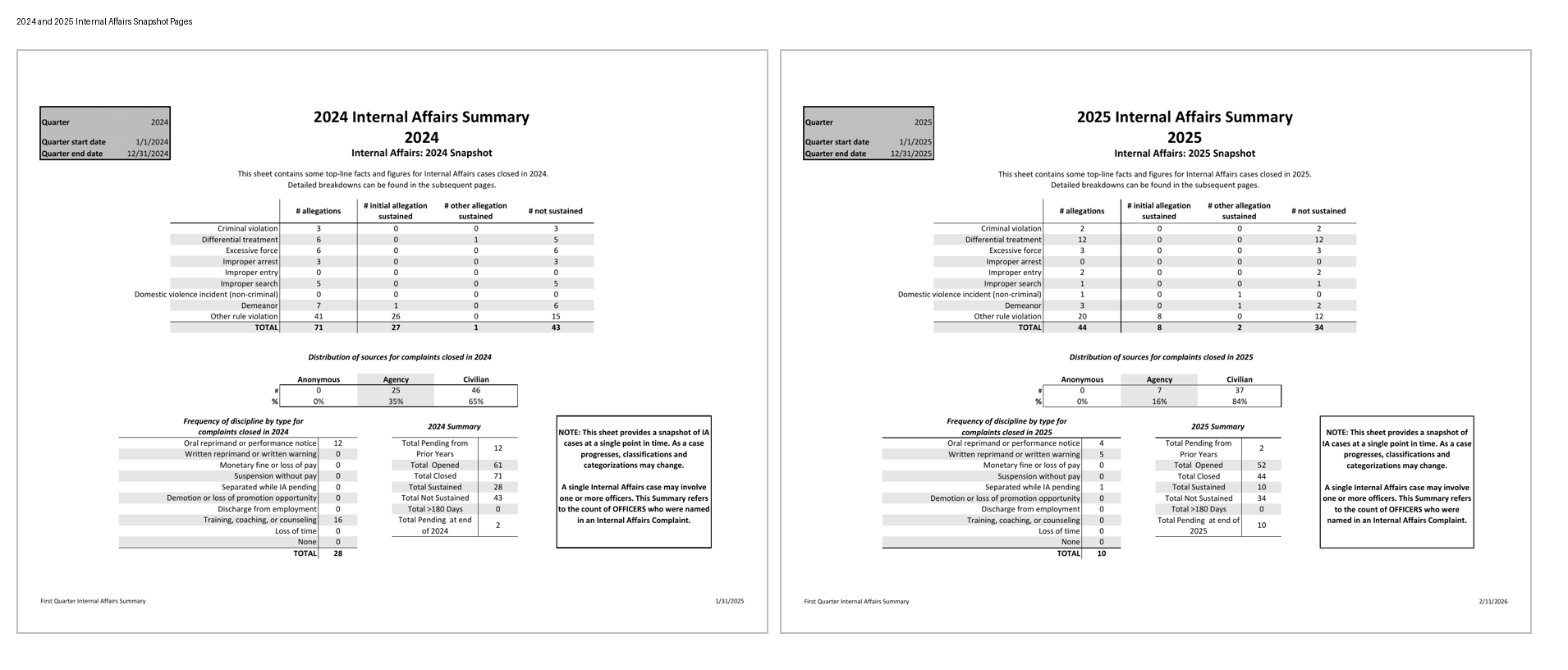
Cherry Hill Police closed 71 internal affairs cases in 2024 and 44 in 2025, according to annual reports that show most closed complaints came from civilians. The records also outline how residents can file a complaint, what the department’s findings mean, and how discipline is tracked in the aggregate.

People Seeking Help Quitting Nicotine Say New Jersey’s Quitline Link Routed Them to a Scam Pitch Line
It starts on an official New Jersey government page, then sends desperate people to a quitline website. One tap on “Call Now,” and some callers say they’re hit with “special offers” for people over 50 and prompts to hand over personal information.